
Discover The World of Psychology

The Importance of Mental Health

-
Cognitive Function & Decision-Making: Good mental health supports clear thinking, problem-solving, and decision-making by reducing the cognitive load from stress and anxiety.
-
Brain-Body Connection: Poor mental health is linked to increased inflammation, weakened immune function, and a higher risk of cardiovascular diseases.
-
Neuroplasticity & Resilience: A stable mental state enhances brain plasticity, helping individuals adapt to new challenges and recover from adversity.
-
Stress Regulation: Mental well-being helps regulate cortisol levels, preventing chronic stress, which can lead to high blood pressure and metabolic disorders.
-
Memory & Learning: Chronic anxiety and depression negatively impact the hippocampus, reducing memory retention and learning efficiency.
-
Social Functioning: Mental health affects relationships, social interactions, and the ability to form strong support networks, which are essential for psychological resilience.
-
Work Productivity & Performance: Poor mental health leads to decreased concentration, absenteeism, and reduced work efficiency, affecting career progression.
-
Physical Health Outcomes: Mental disorders like depression are associated with increased mortality rates, partly due to poor self-care and higher rates of smoking, alcohol use, and sedentary lifestyles.
-
Sleep Quality & Recovery: Mental health influences sleep cycles, and poor mental well-being is linked to insomnia, which can further impair cognitive and physical function.
-
Longevity & Quality of Life: Individuals with good mental health have longer life expectancies and better overall well-being due to improved coping mechanisms and emotional stability.
Beyond the Mind
Some of The Brilliant Minds That Revolutionized Psychology


What If We Followed the Wrong Psychologist?

For over a century, modern psychology has largely followed the path laid out by Sigmund Freud, placing childhood trauma, unconscious conflict, and past experiences at the heart of mental health treatment. Entire therapeutic models and industries have been built around this retrospective approach. But what if we were wrong? What if healing isn’t found by endlessly analyzing the past, but by focusing on the present and future, as Alfred Adler once argued? It’s time to question the foundations we've taken for granted.
Sigmund Freud’s perspective on mental health centers around the belief that a person’s psychological issues are rooted in unresolved experiences from childhood, particularly involving parents and early trauma. In his view, the subconscious mind holds repressed memories and conflicts that continue to influence a person's thoughts, emotions, and behaviors well into adulthood. Healing, according to Freud, requires individuals to return to these early life events through intensive psychoanalysis. By bringing unconscious material to conscious awareness, the individual can gain insight and potentially resolve their inner conflicts. However, this model often emphasizes prolonged exploration of the past, with change being a slow process built around analysis and interpretation.
Alfred Adler proposed a more forward-looking and empowering approach. While he did not dismiss the significance of early experiences, he argued that people are not determined by their past but by the goals they set for themselves and the meaning they assign to their lives. Adler emphasized present beliefs, social connectedness, and personal responsibility. For him, healing involves cultivating a sense of purpose, building meaningful relationships, and choosing directions in life that matter. Rather than remaining stuck in the analysis of prior wounds, Adler encouraged individuals to take conscious control of their lives in the present moment. His approach promotes action, growth, and optimism, focusing on what can be changed rather than what has already occurred.

Effective Strategies to Enhance Your Focus and Memory
-
Engage in Lifelong Learning
Keeping your mind active through continuous learning whether it's acquiring new skills, exploring hobbies, or taking up a course stimulates mental activity and supports cognitive resilience. -
Stimulate Your Brain with Challenges
Activities that challenge your thinking, such as puzzles, games, or strategic problem-solving, help strengthen neural connections and improve memory performance. -
Use Sensory Associations
Research suggests that linking visual images with specific scents can enhance memory recall, even when the scent is not present by activating deeper cognitive pathways. -
Adopt a Positive Outlook on Aging
Embracing a positive mindset about aging has been associated with better memory, improved focus, and sustained cognitive function over time. -
Leverage Organizational Tools
Utilizing planners, reminders, or digital calendars helps offload routine memory tasks, allowing you to conserve mental energy for more critical thinking and decision-making. -
Practice Reading Aloud
Reading or verbalizing information can significantly improve memory retention and comprehension by engaging multiple sensory and cognitive systems.

"Some people use their brains for good, others for bad, and some just set it aside. Which one are you?"
- Psy.G.Al -

Our Approach
The approach is grounded in the rigorous application of psychological principles to conduct research that advances the understanding of critical issues in mental health and cognitive psychology. By employing evidence-based methodologies, the aim is to explore the complexities of cognitive functions such as memory, attention, and decision-making, as well as the underlying mechanisms of mental health conditions like anxiety, depression, and addiction. Our research seeks not only to contribute to the scientific community but also to raise awareness about these pressing issues, promoting informed dialogue and enhancing public understanding of the mind’s intricate workings. Through this approach, the goal is to bridge the gap between research and real-world applications, fostering greater mental well-being and cognitive resilience.
🧠 Neuroimaging & Neurophysiology Comparison
In cognitive and neuropsychology, EEG, MEG, PET, and fMRI provide complementary windows into brain function. EEG and MEG directly measure neural activity with millisecond precision, making them ideal for understanding when cognitive processes such as attention, memory encoding, or decision-making occur. fMRI measures blood oxygen changes, offering high spatial resolution to show where these processes take place within functional brain networks. In contrast, PET reveals metabolic and neurochemical activity, helping explain why cognitive changes occur by identifying underlying molecular mechanisms, such as glucose metabolism or amyloid accumulation.
Together, these methods reflect different layers of brain function: EEG and MEG answer when cognitive events occur; fMRI answers where they occur; PET explains which metabolic or neurochemical mechanisms support or disrupt them. In cognitive and neuropsychology, integrating these approaches allows researchers to move from observable behavior and test performance to temporal dynamics, neural circuits, and molecular substrates. This multi-level perspective is essential for advancing models of memory, decision-making, attention, and clinical cognitive impairment.

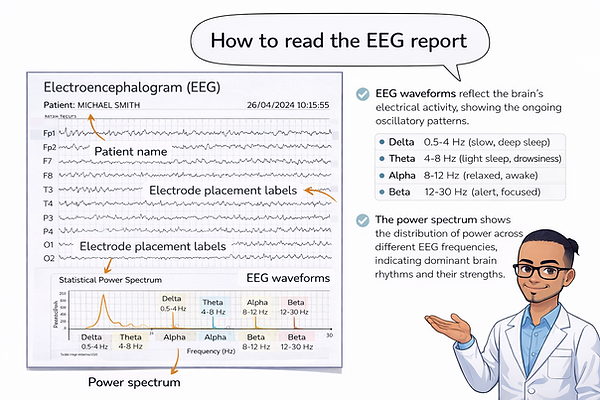
Reading an EEG chart starts with identifying the background rhythm and checking whether it matches the patient’s state. In a relaxed, awake adult with eyes closed, you should see a posterior dominant alpha rhythm (8-12 Hz) over the occipital electrodes, which normally attenuates when the eyes open. Excess theta (4-8 Hz) or delta (0.5-4 Hz) activity while the person is awake may indicate abnormal slowing. It is also important to recognize beta activity (13-30 Hz), which is associated with alertness and can increase with certain medications. Always pay attention to artifacts: eye blinks produce large slow deflections maximal at Fp1 and Fp2, and the Bell phenomenon causes upward eye movement during blinking that can mimic frontal activity. Muscle tension appears as fast, irregular activity, while power line noise shows a consistent 50-60 Hz rhythm. Distinguishing true cortical patterns from artifacts is essential for accurate interpretation.

🧠 Neurocognitive Network Dynamics and EEG-Based Functional Assessment
Cognitive and emotional processes are grounded in the dynamic electrical activity of the brain, which can be objectively measured using electroencephalography (EEG). EEG captures neural oscillations that reflect cortical excitability, synchronization, and information processing across distributed networks. Through artifact correction and source estimation techniques, these signals can be interpreted to identify functional activity within executive control circuits, affective regulation systems, reward pathways, and predictive processing networks. Variations in frequency bands such as theta, alpha, and beta are associated with attentional control, inhibitory regulation, motivational drive, and cognitive efficiency. When these oscillatory patterns become imbalanced or poorly regulated, they indicate dysfunction within specific neural circuits, contributing to conditions such as attention deficits, mood disorders, compulsivity, or neurodegenerative decline. This neurocognitive perspective frames psychopathology as measurable dysregulation in brain network dynamics and supports targeted interventions aimed at restoring functional neural balance.

Describe your image

Describe your image

Describe your image
Describe your image
Key Insights
Innovative Solutions
Our in-depth articles explore the forefront of psychological research, with a strong focus on cognition, memory functions, and addictions. We offer innovative solutions and cutting-edge insights into these critical areas, providing thought-provoking perspectives for both professionals and enthusiasts. For collaboration opportunities or to contribute to our growing body of research, please don’t hesitate to contact us. Together, we aim to advance the understanding of the human mind through rigorous inquiry and scientific excellence.

StatSphere: Your Data Compass
An educational hub to choose, run, interpret, and report statistical tests in R and SPSS.
Note: Click on the icon to open this tool.

Diagnostic Tool
The purpose of this tool is to teach you about physical and mental illnesses and their treatments. This tool is linked to ICD-10 and DSM-5. This tool is educational and is proposed to share information and awareness.
Note: Click on the icon to open this tool.

PsyTheraVerse
A compact catalogue of psychological therapies and assessments - clear, educational, and evidence-based.
Note: Click on the icon to open this tool.
News
➤ Depression, a common yet treatable mental health disorder affecting over 250 million people globally disrupts mood, behavior, and thought processes. Symptoms can range from persistent sadness, loss of interest, appetite, and sleep changes, to fatigue, slowed speech, difficulty concentrating, and even suicidal thoughts. Its development is influenced by factors such as brain chemistry, genetics, personality traits, and environmental stressors like abuse or poverty. Standard treatments include antidepressants, psychotherapy (including cognitive behavioral therapy), and, for severe cases, electroconvulsive therapy. Globally, about 1 in 15 adults experience depression annually, and 1 in 6 will suffer from it at some point. According to WHO estimates, the highest rates of depression in 2024 are found in Ukraine (6.3%), the United States (5.9%), Australia (5.9%), Estonia (5.9%), Brazil (5.8%), Portugal (5.7%), Greece (5.7%), Belarus (5.6%), Finland (5.6%), and Lithuania (5.6%), while Pacific Island nations such as the Solomon Islands (2.9%), Papua New Guinea (3%), and Timor Leste (3%) report the lowest rates. These figures may understate the true global prevalence, especially in less developed regions where diagnosis and treatment are limited by resource constraints and social stigma.
➤ Bibliometric analysis reveals that research on anxiety disorders, the world’s most common mental health condition, has experienced a significant surge over the past decade. Between 2010 and 2023, the number of scholarly publications increased dramatically, rising from an estimated 500 papers in 2010 to nearly 1,800 in 2023. With approximately 20,000 publications and 300,000 citations recorded over this period, the data underscores a growing global commitment to understanding and addressing anxiety. Key contributors in this expanding field include the United States, the United Kingdom, China, Germany, and Australia, with frequent research themes centered on anxiety, mental health, treatment approaches, depression, and stress. This upward trend in academic inquiry reflects not only the increasing prevalence of anxiety disorders but also the urgent need for effective interventions and informed public health strategies, as highlighted by the National Institute of Mental Health.
➤ Recent reports indicate a significant decline in youth mental health across various countries. A UN-commissioned study by Jean Twenge and David Blanchflower reveals that the traditional U-shaped pattern of happiness, where youth is considered carefree, midlife is challenging, and later life is more comfortable, no longer holds. Instead, satisfaction now rises steadily with age. The study, analyzing survey responses from six English-speaking countries, attributes this trend to factors such as the rise of smartphones, social media, cyberbullying, and body shaming, leading to declining happiness and life satisfaction among young people, particularly young women.